Traditional recurring payment methods such as post-dated cheques and manual bank instructions are increasingly being replaced by digital systems that are faster, more accurate, and easier to manage. In India, e-NACH and e-Mandate are widely used frameworks for automating recurring payments across industries.
These systems allow businesses to collect payments automatically from customers' bank accounts based on prior approval. From loan EMIs and insurance premiums to SaaS subscriptions and utility payments, e-NACH and e-Mandates play a critical role in streamlining recurring payments for businesses in India while reducing operational effort and payment delays.
Automate Recurring PaymentsWhat is e-NACH
e-NACH is an electronic system used to automate recurring debit transactions between bank accounts in India. It enables businesses to collect payments on predefined dates after a customer authorizes the debit mandate.
A NACH payment refers to a transaction processed through the National Automated Clearing House framework, commonly used for automated debit transactions in recurring payment setups.
e-NACH is primarily used for high-volume, recurring payments such as loan repayments, subscription fees, insurance premiums, service retainers, and contractual service fees.
How Does e-NACH Work
e-NACH follows a structured, bank-led flow to execute recurring debit payments after customer approval.
- Mandate creation
The customer provides digital consent to allow periodic debits from their bank account. This consent includes frequency, amount or amount range, and validity period.
- Mandate authentication
The mandate is authenticated through net banking, debit card, or other bank-supported verification methods.
- Registration with banks and NPCI
The authenticated mandate is registered with the customer’s bank and routed through the National Payments Corporation of India for validation.
- Scheduled debit execution
On the scheduled date, the business submits a debit request. Funds are automatically debited from the customer’s account and credited to the business account.
- Status and reconciliation
Success or failure status is shared electronically, making reconciliation faster and more accurate for finance teams.
Benefits of e-NACH
- Consistent and timely collections
e-NACH allows businesses to collect recurring payments on fixed schedules without relying on manual reminders or follow-ups. This improves payment discipline and reduces delays that are common in B2B transactions.
- Lower operational effort for finance teams
By automating debit execution, e-NACH reduces manual work related to payment tracking, bank coordination, and follow-ups. Digital records also simplify reconciliation and month-end closing.
- Improved cash flow visibility
With predefined debit dates and automated execution, businesses gain clearer visibility into expected inflows. This helps finance teams plan working capital and manage cash positions more accurately.
- Reduced payment failures and exceptions,
e-NACH transactions follow a standardized banking framework, which lowers the risk of errors caused by manual processing. This leads to fewer failed debits and cleaner payment cycles.
- Scales easily for high-volume recurring payments.
e-NACH is designed for bulk and recurring collections. As customer volumes grow, businesses can handle larger payment volumes without increasing operational complexity.
What is e-Mandate
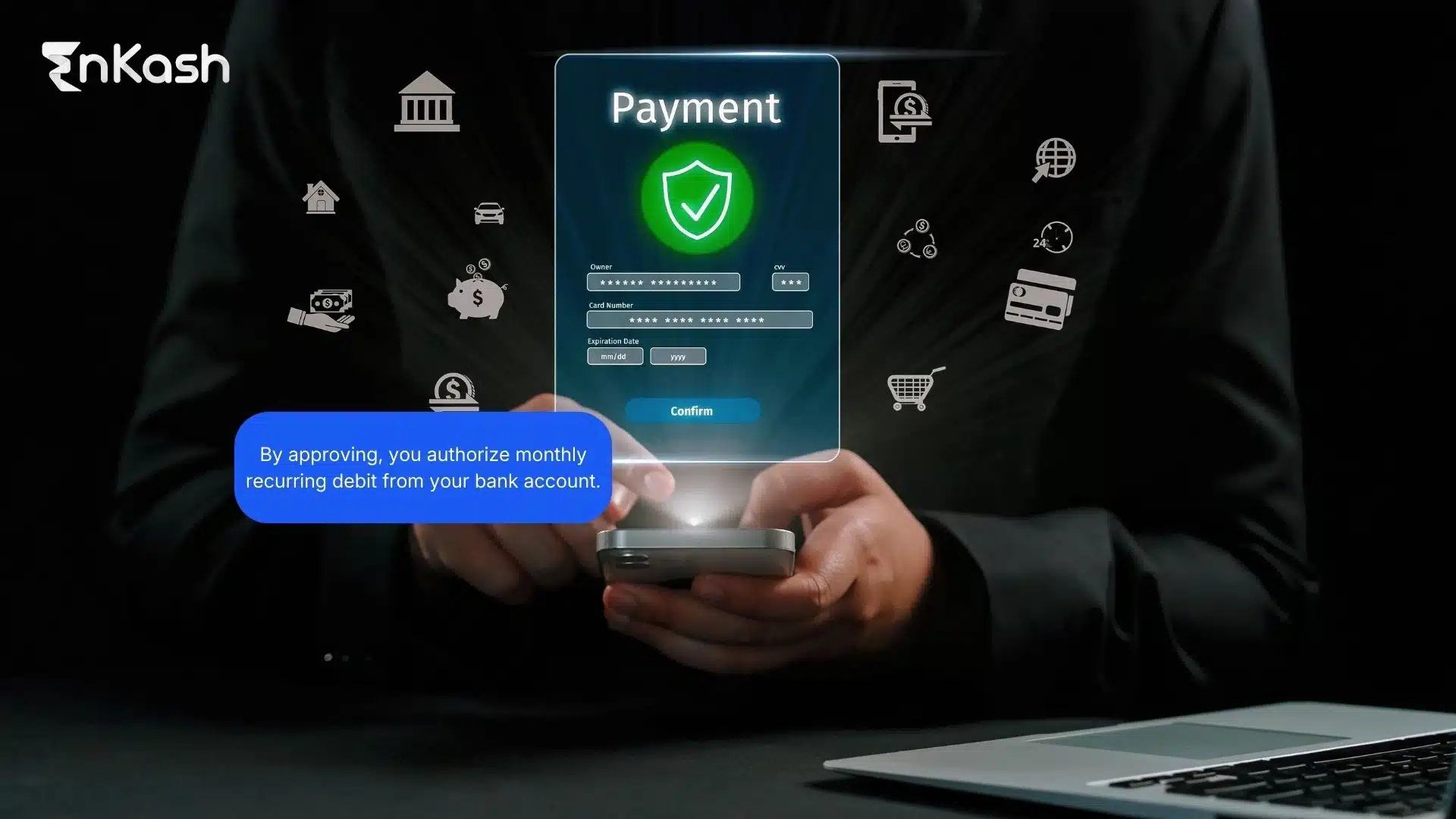
An e-Mandate is a digital authorization provided by a customer that allows a business to debit funds from the customer’s bank account. It serves as formal consent for automated payments and defines key terms such as debit frequency, amount, and validity period.
e-Mandates are primarily used for recurring or variable recurring debit instructions and, in limited cases, for one-time authorized debits. Once approved by the customer’s bank, the mandate is stored electronically and can be used to trigger automated debits without requiring repeated customer approval for each transaction.
How e-Mandate Works
- Mandate submission by the customer
The customer submits mandate details digitally, including bank account information, debit amount or limit, frequency, and validity period.
- Customer authentication
The mandate is authenticated using bank-approved methods such as net banking or debit card verification to confirm consent.
- Bank verification and approval
The customer’s bank verifies the mandate details and approves the authorization based on internal checks.
- Digital mandate registration
Once approved, the e-Mandate is stored electronically and linked to the merchant or business initiating the debits.
- Usage for debit execution
The approved e-Mandate is used to initiate one-time or recurring debits as per the agreed terms without requiring further customer action.
Benefits of e-Mandate
- Paperless and faster authorization
e-Mandates remove the need for physical forms, signatures, and in-branch visits. Digital submission and authentication reduce the time required to set up payment authorization.
- Clear customer consent and control
Customers approve mandate terms such as amount, frequency, and validity upfront. This clarity reduces disputes and improves transparency in recurring payment arrangements.
- Easier mandate management
e-Mandates can be modified or cancelled digitally through banks or authorized platforms. This simplifies mandate lifecycle management for both customers and businesses.
- Lower operational errors
Digital authorization reduces errors caused by manual data entry, misplaced documents, or incomplete forms. This results in cleaner approvals and fewer mandate rejections.
- Supports both recurring and one-time payments
e-Mandates are flexible and can be used for recurring debits as well as specific one-time payment instructions, depending on business requirements.
Key Differences Between e-NACH and e-Mandate
| Basis | e-NACH | e-Mandate |
| Primary role | Executes recurring debit payments | Authorizes debit permissions |
| Nature | Payment clearing and settlement system | Customer consent mechanism |
| Usage type | Recurring payments only | One-time and recurring payments |
| Dependency | Requires an approved mandate to operate | Can exist independently of e-NACH |
| Typical use cases | EMIs, subscriptions, insurance premiums, B2B contracts | Debit authorization for banks and merchants |
| Scale suitability | Designed for bulk and high-volume transactions | Used at the individual customer level |
| Operational focus | Payment execution and settlement | Authorization and control |
Conclusion
e-NACH and e-Mandate play a central role in how businesses manage recurring payments in India. By enabling automated debits with clear customer authorization, they help reduce payment delays, manual effort, and reconciliation issues in B2B transactions.
For businesses handling high volumes of repeat payments, these frameworks bring better cash flow visibility, operational efficiency, and scalability. As digital payment adoption continues to grow, e-NACH and e-Mandate remain essential tools for building reliable and compliant recurring payment processes.
FAQs
1. What is e-NACH used for?e-NACH is used to automate recurring debit payments for EMIs, subscriptions, insurance premiums, and B2B contracts.
2. Is e-Mandate mandatory for e-NACH payments?Yes. A valid e-Mandate is required before any e-NACH debit can be processed.
3. What is the difference between e-NACH and e-Mandate?e-NACH handles the execution of recurring payments, while e-Mandate provides customer authorization for debiting funds.
4. Are there any NACH charges for customers?Customers are generally not charged. Any applicable NACH or mandate charges are typically borne by the business or service provider.
5. Can an e-Mandate be cancelled or modified?Yes. Customers can cancel or modify an e-Mandate through their bank or authorized digital channels, subject to bank-specific processes.
6. Is Aadhaar mandatory for e-Mandate registration?No. Aadhaar is not mandatory. Most banks support authentication through net banking or debit card.