Every registered company in India receives a unique code at the time of incorporation. This code is called the Corporate Identification Number. In day-to-day business, many people also refer to it as the CIN or CIN number. It helps regulators, banks, vendors, investors, and compliance teams identify a company correctly in official records.
The Corporate Identification Number is issued and maintained by the Registrar of Companies (RoC) under the Ministry of Corporate Affairs.
If you run a business, review vendors, handle finance operations, or check company details before a transaction, understanding this code is useful. A CIN helps link a company to its registration history, legal status, and key filing details. It also appears on official company documents under Indian company law.
In the sections ahead, you will understand the meaning of a CIN, the logic behind its format, the information it contains, how it is assigned to a company, and the process for verifying it through official sources.
What is a Corporate Identification Number (CIN)
At the legal level, a corporate identification number is the official code assigned to a company after registration in India. Under Section 7(3) of the Companies Act, 2013, the Registrar of Companies assigns the Corporate Identification Number to a company at the time of incorporation. It works as the company’s recorded identity within the Ministry of Corporate Affairs framework. When a business files forms, appears in public records, or prints statutory details on formal documents, this code helps link that company to the correct registration trail.
The search for what is CIN usually comes from a need for quick clarity without legal complexity. In plain terms, it is the registration-linked identity code given to a company under Indian company law. It helps authorities, financial institutions, vendors, and internal compliance teams confirm that the company exists as a registered entity and can be traced through official records.
A CIN is issued to companies incorporated under the Companies Act, such as private limited companies, public limited companies, one-person Companies, Section 8 companies, and government companies. It does not apply to every business form in India. Sole proprietorships and partnership firms do not receive this code. Limited Liability Partnerships follow a separate identification system.
This distinction is important in finance and compliance work. If a document mentions a company identity code, the first step is to verify what type of entity is involved. A registered company will carry this identifier as part of its legal and administrative record, which makes it easier to review filings, match records, and confirm entity details during business checks.
How Many Characters are in a CIN Number
A CIN Number Format follows a fixed 21-character alphanumeric format. It is not a random mix of letters and digits. Each position carries a specific meaning linked to the company’s registration profile. This is why the code can help identify basic company details even before you open a full company record.
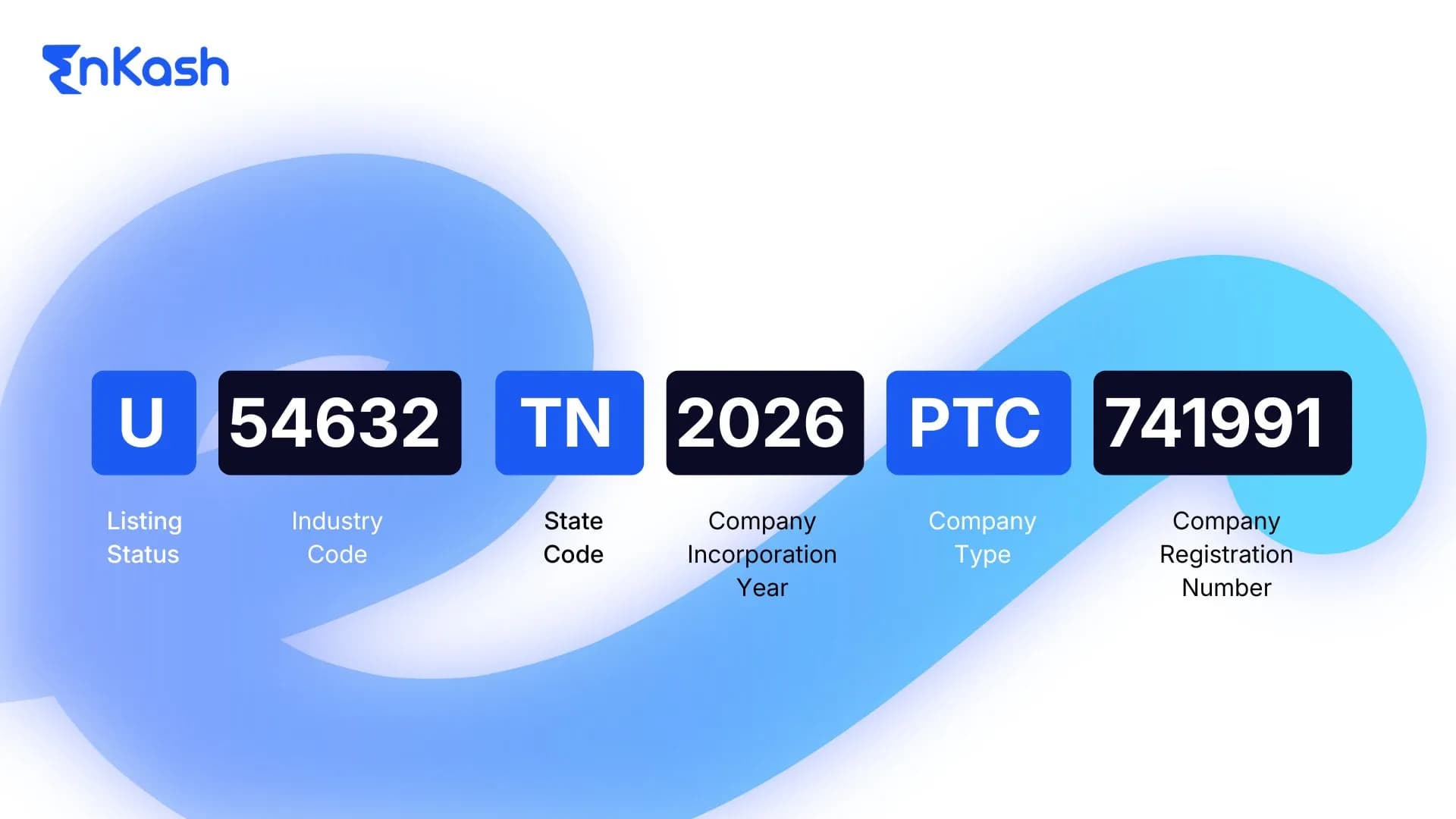
A Corporate Identification Number follows a structured 21-character pattern. Each segment of the code represents specific information about the company, including its listing status, industry classification, registration state, and incorporation details.
CIN Structure Explanation
| CIN Segment | Meaning |
|---|
| First letter | Listing status of the company. L indicates a listed company and U indicates an unlisted company. |
| Next 5 digits | Industry classification code based on the National Industrial Classification (NIC) used during company registration. |
| Next 2 letters | State code indicating where the company is registered with the Registrar of Companies (for example DL for Delhi, MH for Maharashtra). |
| Next 4 digits | Year of incorporation of the company. |
| Next 3 letters | Company classification, indicating the type of company such as PLC (Public Limited Company) or PTC (Private Limited Company). |
| Last 6 digits | Unique registration number assigned by the Registrar of Companies. |
Full Structural Layout of a CIN
A CIN is structured in six segments, each representing specific company details. The first character indicates whether the company is listed or unlisted on the stock exchange. The next five digits represent the industry code based on the National Industrial Classification (NIC) used in company registration. After that, two letters indicate the state in which the company is registered. The next four digits represent the year of incorporation. The following three characters point to company classification. The last six digits form the company’s registration number.
What Each Section of the Code Represents
The opening character gives an early legal clue. A listed company and an unlisted company do not begin the same way. The five-digit industry segment helps identify the broad line of business recorded for the company. The two-letter state code helps locate the jurisdiction of registration. The year segment tells you when the company entered the records. The next three characters indicate the company category and ownership pattern. The final six digits work as the specific registration sequence for that entity.
Abbreviations Used Inside the Code
Many readers look for abbreviations in CIN numbers because the letters can feel technical at first glance. State codes are usually the easiest part to recognise. For example, DL refers to Delhi, and MH refers to Maharashtra. Other letters inside the code indicate the type or class of company recorded at incorporation. These abbreviations help regulators and users read company details quickly in a standard format.
Example of a CIN
Take a sample code such as L12345MH2020PLC123456. The first letter, L, shows a listed status. The next five digits, 12345, represent the industry classification recorded for the company. MH points to Maharashtra. The year 2020 marks the year of incorporation. PLC indicates the company type in this example. The final six digits, 123456, are the registration number attached to that company. This example shows how a company incorporation number contains multiple pieces of registration data within a single code.
How to Read a CIN at a Glance
A quick read can reveal the company's registration status, incorporation year, and parts of its legal profile. This becomes useful during onboarding checks, vendor reviews, document validation, and record matching. In finance and compliance work, speed and accuracy both carry weight. A properly read CIN reduces the chance of mixing one entity with another and helps teams move to the correct company record without confusion.
Importance and Uses of CIN
Legal Identity and Entity Distinction
A CIN gives a registered company a fixed identity in the corporate system. Names can look similar. Business activities can overlap. Directors can change over time. This code helps distinguish one company from another in a clear, traceable way. In finance and compliance work, that clarity helps reduce record mismatch and lowers the chance of using the wrong entity details in filings or internal checks.
Transparency Through Official Company Records
A corporate identification number helps connect a company to official records maintained under the MCA framework. Once that connection exists, users can review core registration details with greater confidence. This is useful when a business is being reviewed before a payment relationship, vendor onboarding, service agreement, or documentation check. A verified company identity helps support cleaner business decisions and better compliance discipline.
Companies use this code in statutory filings, formal records, and specified business documents. It serves as a reference point for authorities, banks, auditors, counterparties, and internal teams to identify the correct legal entity. In practical terms, it helps match the company name on a document with the company record available in the system. This makes routine review work faster and more reliable.
Application in Verification and Due Diligence
A company ID becomes useful when a team needs to confirm that a company is a legally registered entity, and correctly described in paperwork. During vendor checks or counterparty reviews, the code can support entity validation before contracts, invoices, or onboarding records are processed. This is a simple yet important control step in many finance operations, where even a minor identity error can lead to larger compliance issues later.
Practical Value for Finance and Compliance Teams
For business owners, finance teams, auditors, and compliance professionals, CIN works as a quick reference anchor. It helps confirm that records, filings, and formal communications point to the same legal entity. That reliability becomes useful when decisions depend on correct company data. In regulated workflows, identity-level accuracy is basic but carries real weight across documentation, verification, and reporting.
How to Get a CIN Number in India
Allotment Through Company Incorporation
A corporate identification number is issued when a company is incorporated in India. It is included in the registration outcome and is linked to the company once the incorporation process is approved by the Registrar of Companies under the Companies Act, 2013. The law places incorporation within Chapter II, and the certificate of incorporation serves as conclusive evidence that the company has been registered.
No Separate Application Route
Many people search for how to get a CIN number as if it were a separate post-registration step. In practice, that is not how the system works. A company does not file an isolated request for this code after incorporation. The number is generated as part of the company registration process itself, which means the route to getting it begins with incorporating the company correctly.
Basic Process that Leads to CIN Allotment
The process begins with an incorporation filing under the MCA framework. Once the required incorporation documents and declarations are submitted and accepted, the Registrar issues the certificate of incorporation. At that stage, the company is entered in the official record and receives its CIN number as part of that registration. This sequence is important because the code is tied to legal formation, not to a later request or a separate approval track.
Documents Required to Get a CIN Number
Incorporation Documents Connected to CIN
A corporate identification number is issued when a company is registered. There is no separate document list for CIN alone. The required papers are those used for company incorporation. Under Section 7 of the Companies Act, 2013, the filing includes the memorandum, the articles, a declaration that the legal requirements have been complied with, and the details of the subscribers and the first directors.
Identity and Office Details
The company must also submit identity and address details of the people setting it up. Registered office details are also required. These records help the Registrar confirm who is forming the company and where the company is legally based. This creates the company’s formal record from the start.
Document Needs Can Vary
The exact papers may vary depending on the type of cSection 12(3)(c) states that every company shall get its nameompany and the filing route used. A private company, one-person company, or Section 8 company may not follow the same paperwork pattern in every case. Once the incorporation filing is accepted, the company is registered, and the CIN is allotted through that process.
How to Check CIN or Do a CIN Search
Official Source for Company Lookup
The safest way to verify a company code is through the MCA record system and public company master data. The Ministry of Corporate Affairs provides public access to company master data through the MCA21 portal, which allows users to search using the company name or CIN. These records help users confirm whether the company exists in the official register and whether the details match the entity they are reviewing. For finance teams, this step helps reduce basic onboarding and documentation errors.
Search Using Company Name or Code
A CIN search usually begins with the company name. If the code is already available, users can search with that as well. This helps pull up the correct company record faster. In practical use, the search is meant to confirm identity, not to guess details from incomplete paperwork.
Details Visible in the Record
Once the correct record is found, users can review the company name, registration status, Registrar of Companies details, incorporation date, and other public fields linked to the entity. A CIN check process helps match the company on paper with the company in the official records.
Use in Verification and Review Work
A CIN number search is useful during vendor checks, counterparty reviews, account-opening support, compliance checks, and document validation. If names look similar or records appear incomplete, this lookup step helps teams work with the right legal entity from the start.
If a company’s CIN is U12345DL2018PTC123456, the first letter “U” indicates an unlisted company, “DL” indicates registration in Delhi, and “2018” shows the incorporation year.
When Can a Corporate Identification Number Change
Change is Allowed Only in Limited Cases
A corporate identification number does not change during routine business activity. A company can appoint new directors, update internal records, or revise its business plans without changing this code. The change occurs only when a part of the coded information in the official record changes.
Change in Listing Status
The first character of a CIN reflects whether the company is listed or unlisted. If that status changes, the first character of the code may change. This is because the code must continue to match the company’s legal position in the official register.
Change in Registered Office from One State to Another
The CIN also carries the state code of registration. If a company shifts its registered office from one state to another, the state's code may change. In such cases, the company is required to obtain the revised code from the new Registrar of Companies office.
Change in Industry Classification
A CIN number also includes the industry code linked to the company’s recorded business classification. If that classification is formally changed in the official records, the relevant part of the code may be revised to reflect the updated sector position.
Penalty for Non-Compliance in Mentioning CIN
Mandatory Mention on Official Company Documents
Indian company law requires every company to print its corporate identification number on business letters, billheads, letter papers, notices, and other official publications. This is a statutory disclosure requirement under Section 12(3)(c) of the Companies Act, 2013.
Legal Basis Under the Companies Act, 2013
The requirement to display the CIN is specified under Section 12(3)(c) of the Companies Act, 2013. Section 12(3)(c) states that every company shall get its name, registered office address, CIN, telephone number, fax number, if any, email and website addresses, if any, printed on its business letters, billheads, letter papers and in all its notices and other official publications.
Penalty for Default
Section 12(8) provides that if a company defaults in complying with Section 12, the company and every officer in default shall be liable to a penalty of ₹1,000 for every day during which the default continues, subject to a maximum of ₹1,00,000.
Conclusion
A proper understanding of the CIN number format helps turn a technical-looking code into meaningful registration detail. It helps you read key registration details faster, verify whether records align, and reduce errors during review. In finance and compliance work, that kind of clarity supports better decisions and cleaner documentation.
A CIN check becomes important when teams review vendor records, examine company documents, or process onboarding checks. A proper CIN search helps confirm that the legal entity mentioned in the paperwork matches the entity listed in official records. This helps prevent incorrect record mapping, weak due diligence, and avoidable compliance lapses. For finance and compliance teams, that check supports cleaner documentation, better control, and stronger confidence before any approval moves forward.
FAQs
1. What is the main purpose of a CIN for a company?A CIN helps identify a registered company in official records. It links the company to its legal registration trail under the corporate system. This helps regulators, banks, auditors, vendors, and businesses confirm that the entity named in a document matches the entity recorded in government-linked company data.
2. Where can I verify if a company’s CIN is genuine?You can verify a company’s CIN through MCA-linked company lookup records and public company master data. These sources help confirm the company name, registration status, incorporation details, and related record fields. Verification is useful before onboarding, contracting, document review, or making decisions based on company identity.
3. Why is CIN important before signing a business contract?CIN helps confirm that the company in the contract is a legally registered entity. This reduces the risk of dealing with the wrong business, using incomplete records, or relying on inaccurate paperwork. For finance and compliance teams, that check supports cleaner contracting, onboarding, and internal approval processes.
4. What can happen if a company prints the wrong CIN on its documents?A wrong CIN can create a mismatch between the document and the company’s legal record. That can affect verification, documentation quality, and compliance review. Since company law requires prescribed disclosures on official documents, incorrect details can also create legal and administrative risk for the company and officers involved.
5. Why do banks and lenders check a company’s CIN?Banks and lenders check CIN to confirm the legal identity of the company they are dealing with. This supports entity validation before account opening, lending review, payment setup, or document acceptance. A verified identity record helps reduce confusion, mismatch risk, and weak due diligence at the onboarding stage.
6. Does a company’s CIN change after every business update?A company’s CIN does not change after routine business updates. Internal changes such as director appointments, management changes, or operational revisions do not alter it automatically. The code changes only when a coded element changes in the official record, such as listing status, registered state, or industry classification.
7. Why is the registered office relevant when reading a CIN?The registered office matters because the CIN includes a state code linked to the company’s registration jurisdiction. This helps identify where the company is legally registered. That detail is useful during record checks, company searches, and compliance reviews that depend on correct jurisdiction and registration mapping.
8. Why do auditors review CIN during compliance checks?Auditors review CIN to connect filings, letters, notices, and supporting records to the correct legal entity. A stable identity reference helps reduce the risk of record mismatch during review. This improves document accuracy and supports stronger verification when checking whether company disclosures and records align properly.
9. Is CIN useful when checking old company records?CIN is useful in older company records because it helps trace the legal identity behind historical documents. Even where names look similar or records are incomplete, the code can support entity matching. This is helpful in audits, legal review, due diligence, and record reconciliation involving older paperwork.
10. Why is CIN important in company notices and letters?CIN is important in notices and letters because company law requires it to appear on prescribed official documents. Printing it helps readers identify the correct company behind the communication. It also supports cleaner documentation and reduces confusion when records are reviewed by regulators, counterparties, auditors, or internal teams.