Appraisal season is more than just another HR process at work. It is a moment when the employees' hard work translates into a salary revision. Employees eagerly wait for their salary increment, as this professional financial jump often ends up shaping their personal decisions.
Compensation is an important factor in employee satisfaction and retention. In BambooHR’s survey of 1,500 full-time salaried employees in the US, 73% said they would consider leaving their current job for higher pay. Although the finding is not India-specific, it shows how strongly compensation can influence retention.
While employees wait for their salary appraisal, there are many questions: What is the percentage hike I actually got? What will be the monthly amount in addition to my salary?
This guide explains how to calculate your salary increment percentage, increment amount, and revised salary.
What is a Salary Increment?
A salary increment is an increase in an employee's current fixed annual salary, generally awarded by an employer based on factors such as performance, promotion, skill development, inflation adjustments, or company-wide increment policies. Unlike one-time bonuses or incentives, a salary increment permanently increases the employee's base salary and directly impacts future earnings, retirement benefits, and other salary-linked allowances. Salary increments help employers show appreciation to their employees and maintain positive retention rates in an organization.
Factors That Affect Salary Increment
Companies consider several factors when deciding salary increments, including business performance and each employee’s contribution. These include:
The most important and determining factor for salary increment is an employee's annual performance. The performance is usually evaluated based on results that are measurable - completing targets, successfully delivering assigned projects, or improving processes that help the business grow. Employees who showcase consistent performance are usually rewarded more than others.
Business Growth
While an employee's performance is an important factor for salary increments, the hike in their salaries is also dependent on the company’s performance. If the company is not in a good position, it gets difficult to reward employees. However, when the company is thriving, they ensure their employees get competitive salaries and rewards.
Salary Trends
Salary increment is not decided in isolation. Companies consider industry salary benchmarks, demand for specific skills, inflation, and broader economic conditions. While giving industry-based increments, companies remain competitive and attract better employees.
Employee Role
The role of the employee in the organization is also a determining factor when it comes to increments. Employees with critical roles impact the company’s performance directly and are preferred over those who are indirectly related to the company’s growth.
Employee Experience
An employee’s experience, specialist knowledge, and scarcity of skills can influence the salary offered for the role. Experience and seniority take the edge over newbies who are exploring the industry and business. Companies value employees whose skills support business needs and whose conduct aligns with organisational values.
Types of Salary Increment
Different companies follow different salary increment approaches. Some offer annual appraisals, some provide variables, while some follow the performance-based increments pattern.
Annual Increments
Many companies review salaries once a year as part of their annual appraisal cycle. Employees get their salary increment once a year.
These increments are usually given to employees who exceed their given targets or showcase exceptional performance at work.
Market Adjustments
This type of salary increment is aligned with the ongoing market rates. Employers try to retain their employees by matching the salaries that are being offered in the industry.
A promotion may include a salary increase to reflect the employee’s expanded responsibilities and higher job level. This promotion-based increment motivates the employees as their careers progress.
Salary Increment Types
| Type | Why is it given | Typical trigger |
|---|
| Annual increment | Regular salary review | Annual appraisal |
| Performance increment | Strong results | Exceeding agreed goals |
| Market correction | Salary below market range | Benchmarking or retention risk |
| Promotion increment | Higher job level | Increased responsibility |
You can either calculate the new salary by using the hike percentage or calculate the hike percentage by using the new salary amount.
If you know the hike percentage, follow the formula:
Current Salary + (Current Salary X Hike Percentage/100)= New Salary
Salary Increment Calculator
A salary increment calculator is an easy-to-use tool to know the exact increase in salary percentage or CTC after the increment. Enter your current salary and revised salary to calculate the hike percentage. Alternatively, enter your current salary and expected hike percentage to estimate the revised salary.
Salary Increment Process in India
Companies usually keep a budget for increments during their annual financial planning, which is used when the appraisal cycle arrives. The distribution of this increment is dependent on multiple factors like employee performance, the company’s profitability, and salary trends in the market.
Companies follow a formal procedure for salary increments, which starts with an employee performance review, which is often conducted annually. This review is done to assess the employee’s performance against the defined KPIs and targets allocated to them. Employee performance is at the core of these reviews and directly impacts the increment percentage.
The HR team is at the centre of this salary increment process as they design policies around increments, collect employee performance data, and define salaries for the role. Managers support them by conducting performance appraisals and giving recommendations. HR and managers together ensure employee increments are aligned with business needs and employee expectations.
How to Calculate Salary Increment
Salary increment calculation follows certain steps, which are mentioned below.
Step 1: Determine Current Salary
Before calculating your increment, confirm which salary figure is being revised. Compare like with like: old CTC with new CTC, old fixed pay with new fixed pay, or old monthly gross salary with new monthly gross salary. Do not compare CTC with take-home salary because they contain different components.
For calculation purposes, ensure you’re using the same time period (monthly or annual) throughout the process to maintain consistency. Additionally, clarify whether you’re calculating based on gross salary or take-home pay, as these figures differ substantially.
Step 2: Apply Increment Percentage
After you have the salary base pay number handy, you can calculate your increment with the following formula:
[(New Salary – Current Salary) / Current Salary] × 100 = Salary Increment Percentage
For example, if the new monthly salary is ₹50,000 and the current monthly salary is ₹40,000, the calculation would be:
((₹50,000- ₹40,000) / 40,000) X 100 = 25%
This means that the salary has increased by 25%.
If you know the increment percentage, you can use that to calculate the actual amount.
Alternatively, if you know the percentage increase beforehand, you can calculate the actual amount of increment using:
Increment Amount = Current Salary × Increment Percentage
And,
New Salary = Current Salary + Increment Amount
For example, if your current month's salary is ₹40,000 and you receive a 15% increment, the calculation would be:
(₹40,000 × 15) / 100 = ₹6,000
This means your monthly salary would increase by ₹6,000.
Step 3: Add to Base Salary
The last step is adding the calculated increment amount to your existing salary.
New Salary = Current Salary + Increment Amount
Once you have calculated your revised salary, review the updated salary breakup carefully. Your CTC hike percentage and the increase in your monthly take-home salary may not be the same.
Why Your Take-Home Salary May Not Increase by the Same Percentage
A 15% increase in CTC does not always mean that your take-home salary will also increase by 15%. CTC represents the total amount a company spends on an employee and may include components that are not paid directly into the employee’s bank account.
For example, the revised CTC may include a higher variable bonus, employer provident fund contribution, gratuity provision, insurance premium, or other employee benefits. Changes in income-tax deductions, employee PF contributions, and professional tax, where applicable, can also affect the final amount credited each month.
Suppose your CTC increases from ₹8 lakh to ₹9.2 lakh annually, which is a 15% hike. If part of the additional ₹1.2 lakh is allocated to variable pay or employer-side benefits, your monthly take-home salary may rise by less than 15%.
Therefore, compare the old and revised salary structures instead of looking only at the overall CTC increase.
How to Negotiate Your Salary Increment?
While the decision to increase the salary is dependent on the company, the right to negotiate for their salary always lies with the employee. To negotiate their salaries, employees need to back their performance with data and industry trends. Follow these ways to negotiate your salary better:
Research and Prepare
You better be prepared for the work you have done and how you present it. Refer to platforms like Glassdoor India to know the industry trends in the market depending on your role, location, and experience.
Reach out to your manager for a one-on-one meeting to discuss your career progression and compensation, giving them time to think about your increment. Present outcomes relevant to your role, such as revenue generated, costs reduced, projects completed, risks controlled, processes improved, or customer outcomes achieved.
Make Your Pitch
Start by stating your commitment to the company and present your achievements using data. Negotiate on a range-based approach instead of a number, and make sure it is realistic. Maintain your professional tone and allow your manager to respond.
Negotiate the Response
While negotiating, be calm and prepared for a NO. If the increment you expect is not coming to you, be curious about the milestones you need to achieve to get a raise next time.
Why does a Salary Increment Matter?
Salary increment becomes an important aspect for employees as it not just reflects financial rewards, but also reflects on the employee's career progression and recognition and the employer’s commitment to retain their employees.
Competitive compensation and meaningful career opportunities can support recruitment and retention, although workplace culture, management and job design also influence attrition.
Industry-wise Salary Hike Standards
These are the average hikes across industries, which are usually followed by the companies.
| Industry | Average Increment |
|---|
| Pharmaceuticals & Life Sciences | 10.0% |
| Automotive | 10.3% |
| Financial Services | 9–10% |
| Manufacturing | 9–10% |
| Consumer | 9% |
| Technology | 8–9% |
Salary Increment Trends in India (2022-2026)
The salary increment trends in India have remained relatively stable at 9% over the past five years. According to the Deloitte's Talent Outlook 2026, the average salary increment is projected at 9.1%.
This means organizations’ are continuously focusing on rewarding performance keeping the balance between business growth and economic growth.
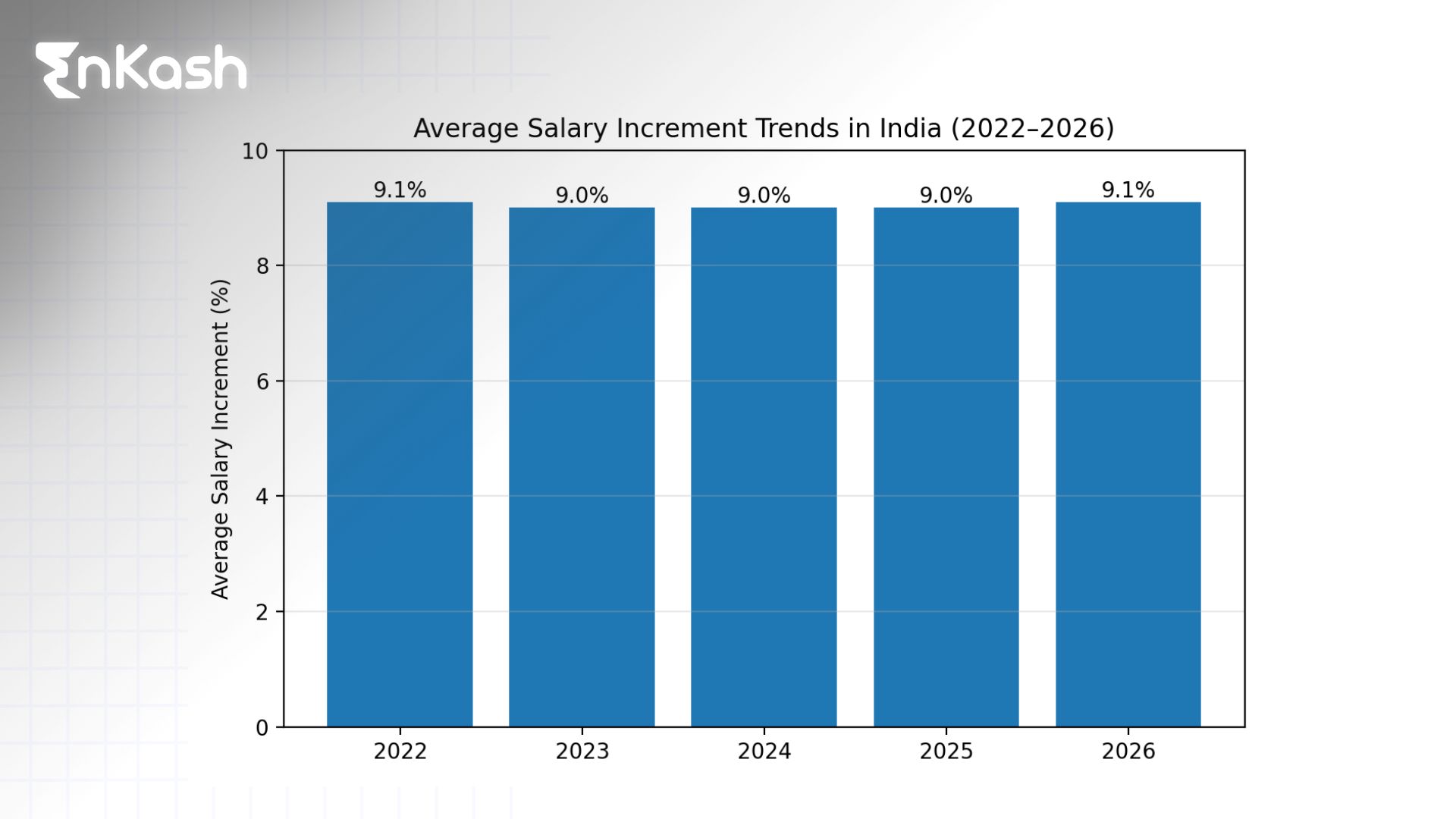
Source: Deloitte India Talent Outlook / Workforce & Increment Trends reports
How to Negotiate Your Salary Increment?
While the decision to increase the salary is dependent on the company, the right to negotiate for their salary always lies with the employee. To negotiate their salaries, employees need to back their performance with data and industry trends. Follow these ways to negotiate your salary better:
Research and Prepare
You better be prepared for the work you have done and how you present it. Refer to platforms like Glassdoor India to know the industry trends in the market depending on your role, location, and experience.
Reach out to your manager for a one-on-one meeting to discuss your career progression and compensation, giving them time to think about your increment. Present outcomes relevant to your role, such as revenue generated, costs reduced, projects completed, risks controlled, processes improved, or customer outcomes achieved.
Make Your Pitch
Start by stating your commitment to the company and present your achievements using data. Negotiate on a range-based approach instead of a number, and make sure it is realistic. Maintain your professional tone and allow your manager to respond.
Negotiate the Response
While negotiating, be calm and prepared for a NO. If the increment you expect is not coming to you, be curious about the milestones you need to achieve to get a raise next time.
What is a Salary Increment Letter and How is it Used?
A salary increment letter, also called a salary revision letter, is issued by an employer to confirm the revised salary and effective date.
What Should an Employer-Issued Salary Increment Letter Include?
- Employee’s full name, position & department
- Effective date of the salary increase
- Current salary and new salary details
- Increment reason like performance, promotion & market adjustment
- Expression of appreciation for contributions
- Signature lines for both employee and employer
A salary increment letter is a formal request that needs to follow a structure to have an impact on the employer.
Follow the format below for a salary increment letter:
[Full Name]
[Job Title]
[Department in the Company]
[Date]
Subject: Salary Increment Discussion Based on Achievements
Hi [Manager Name],
I hope you are doing well.
I am writing this email to request a raise in my current salary structure. During my [Time Duration] with [Company Name], I have contributed to various roles and responsibilities. (Mention projects, goals, or areas of work detail backed by data).
I believe that my performance at work will be considered for a salary increment.
Please find the list of my accomplishments that contributed to the company’s growth:
[Achievement 1]
[Achievement 2]
[Achievement 3]
This increment will help motivate me and contribute to the company’s growth more.
I would be happy to discuss this with you in person.
Yours sincerely,
[Name]
Tips to Write a Salary Increment Letter
Here are a few handy tips to write a good salary increment letter.
- Do market research to know the benchmark in the market for your profile.
- Use professional language and clear intent in the increment letter.
- Ensure your achievements are well highlighted with data.
- Highlight your value and mention how your consistency has contributed to the business.
- Read the salary increment letter carefully.
Conclusion
Salary increment is an important aspect of the corporate world as it puts a number to your hard work and reflects your career progress. It is therefore vital to know how salary increments work and whether they are aligned with your work and industry standards or not. Knowing these numbers always allows you to have a clear picture of your growth metrics.
FAQs
1. What is considered a good salary increment percentage?
The salary increment percentage depends on multiple factors like industry, role, experience, and company growth. There is no universal good salary increment. For context, Deloitte projected an average increment of 9.1% across surveyed Indian organisations for 2026. Your own increment should be assessed against your performance, role, promotion status, industry, location, and current market salary.
2. How should I calculate my salary hike percentage?
Use this formula to calculate salary hike percentage:
((New Salary − Current Salary) ÷ Current Salary) × 100 = Salary Hike %
3. Is the salary increment calculated on CTC or basic salary?
Salary increments may be calculated on CTC, fixed pay, gross salary or a specific salary component, depending on the employer’s compensation policy. Check the appraisal letter and revised salary breakup before calculating your effective hike.
4. Does promotion always include a salary increment?
A promotion does not always result in an immediate salary increase. Sometimes only the designation goes up, but there is no monetary benefit involved, while there are companies that offer both.
5. Can I negotiate my salary after receiving an appraisal?
Yes, salaries can be negotiated after receiving an appraisal if you are not satisfied with it. This can be discussed based on your performance and industry standards.
6. How often do companies revise salaries?
Most companies revise salaries on an annual basis, while some also give mid-year or promotion-based increments.
7. Does a salary increment affect bonuses and PF?
A salary increment may increase your PF contribution and future gratuity if it increases the salary components used for those calculations. An increase limited to bonus, reimbursement or another excluded component may not have the same effect.
8. What is the difference between a salary increment and a promotion?
A salary increase implies your monetary compensation increases, while promotion means your role goes up one rung on the ladder and responsibilities increase.