India’s EdTech market is growing fast, but its payment infrastructure is often built for collection, not complexity.
A single EdTech platform can collect a ₹499 mock test fee, a ₹5,000 cohort booking amount, a ₹75,000 certification fee, a monthly subscription, a semester fee, or a parent-paid school charge. Some payments happen on the website. Some come through WhatsApp links after a counselling call. Some are paid upfront, while others move through EMIs, discounts, partial payments, or renewals.
Each payment has to carry context back into the business: who paid, what they paid for, which course or batch it belongs to, what access should open, what invoice should be created, what amount is still due, and what finance has to reconcile later.
When this context is missing, payment success alone does not solve the problem. It only confirms that money was collected. The real EdTech payment stack begins after that.
What is an EdTech Payment Stack?
An EdTech payment stack is the complete setup that helps an education business collect, track, refund, settle, and reconcile payments across students, parents, courses, batches, counsellors, educators, centres, and finance systems.
It includes the visible collection layer:
- Website and app checkout
- Payment pages
- Payment links
- QR payments
- UPI, cards, digital wallets, net banking
- EMI, pay later, and recurring payments
It also includes the operating layer:
- Student ID and course mapping
- Batch or cohort mapping
- Fee head mapping
- Invoice generation
- Refund tracking
- Settlement tracking
- ERP, LMS, CRM, or SIS integration
- Reconciliation reports
- Partner or educator payouts
This is why EdTech payments need more context than a regular checkout transaction.
A ₹20,000 payment is useful only when the business knows who paid it, which course it belongs to, whether it is full or partial, whether access should start, whether an invoice has been issued, and whether the amount has been settled.
Why EdTech Payments Are Different From Normal Checkout
A regular online checkout usually has one buyer, one order, and one final amount. EdTech rarely works that way.
The payer and learner may be different. Parents often pay for school students. Companies may pay for employee learning. A student may pay part of the course fee while the rest is handled through EMI or a finance partner.
The payment amount may also change. Scholarships, coupons, counsellor-approved discounts, batch transfers, course upgrades, and add-ons can change what the learner finally pays.
The same student may have multiple payment events across the lifecycle:
| Student action | Payment event |
|---|
| Registers for a demo class | Trial fee or zero-fee registration |
| Confirms interest after counselling | Seat booking amount |
| Joins a course | Full fee, EMI, or partial payment |
| Buys extra learning material | Add-on payment |
| Renews access | Subscription payment |
| Cancels or shifts batch | Refund or adjustment |
This is why an EdTech business needs more than a payment gateway that only confirms whether money was collected.
The payment has to update the right student record, open the right access, trigger the right invoice, and show the right amount to finance.
The Visible Payment Layer is Already Well Understood
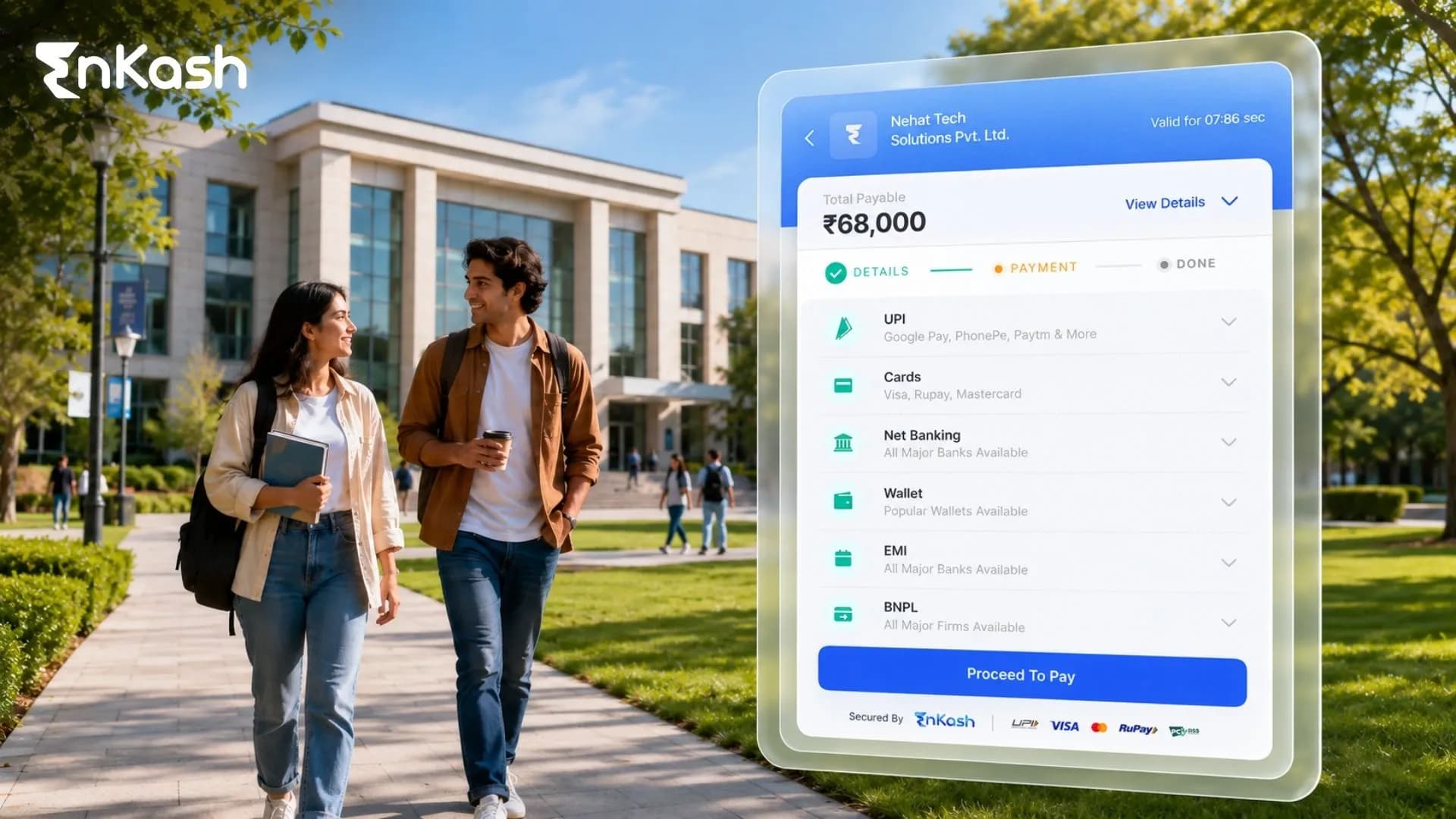
Most payment pages and competitor content talk about the collection layer. They cover multiple payment modes, payment pages, payment links, QR codes, EMI, recurring payments, refunds, dashboards, settlements, and reporting. This is useful because payment convenience does affect conversion.
For example, an EdTech platform with a website needs the payment gateway integrated into the course purchase flow. The learner should be able to choose a course, apply a coupon, pay through UPI or card, and receive confirmation without being pushed into a broken manual process. But many EdTech sales do not happen directly on the website.
A student may attend a webinar, speak to a counsellor, ask questions on WhatsApp, and then receive a payment link. A parent may prefer paying from a link shared after an admission call. A coaching centre may collect seat booking amounts through links before the batch starts. Both flows are valid.
The website checkout supports self-serve buying. Payment links support assisted sales through counsellors, admissions teams, webinars, and WhatsApp conversations. The problem begins when the payment does not carry enough information to the rest of the system.
Where The EdTech Payment Stack Actually Breaks
1. Payment is collected, but course access is delayed
This is one of the most common EdTech payment failures. A student pays successfully, but the LMS does not update on time. The support team checks the payment dashboard. The academic team checks the course platform. The finance team checks the settlement report.
The student sees only one issue: they paid but cannot access the course. This happens when payment collection is integrated, but payment status is not connected to student onboarding.
A stronger stack should pass payment status to the systems that manage course access, student records, invoices, and enrollment confirmation.
2. Counsellor-led payments lose attribution
Many EdTech sales happen after a human conversation. A counsellor may share a payment link after a demo class, webinar, or admission call. The link may be for a trial fee, seat booking amount, discounted course fee, or first installment.
If the payment link is generic, finance may receive the money without knowing the full context.
The business should be able to map:
- Student name or ID
- Course selected
- Counsellor or admissions owner
- Discount applied
- Batch or cohort
- Payment status
- Pending amount, if any
Without this, teams may collect the payment but lose attribution, enrollment accuracy, and follow-up control.
3. High-ticket programmes create partial collection gaps
High-ticket EdTech programmes are rarely paid in one clean transaction. A learner may pay a booking amount first, then the remaining fee through EMI, partial payment, or a scheduled installment plan. Scholarships, coupons, and counsellor-approved offers may also reduce the final payable amount. The risk is that different teams read the same enrollment differently.
Sales may treat the student as enrolled. Operations may reserve a seat. Finance may see only partial collection. The student may expect access because they have paid the first amount.
A proper payment stack should show the listed fee, discount, amount paid, amount pending, EMI status, due date, invoice value, and access rule. This is not a finance detail. It decides whether the business has collected revenue or only recorded intent.
4. Subscription failures become churn
Subscription-based learning platforms depend on renewals.
A student may choose a monthly plan, annual plan, subject-wise plan, test prep subscription, or certification access plan. If the recurring payment fails, the platform has to decide what happens next.
Does the system retry the payment?
Does it send a reminder?
Does access continue for a grace period?
Does the plan downgrade?
Does the student lose access immediately?
A failed payment is not only a payment issue. It can become a retention issue. For subscription EdTech, the payment stack should support renewal reminders, failed payment alerts, retry logic, payment status updates, and access-related actions.
5. Schools and colleges need fee-head-level tracking
The EdTech payment stack is not limited to online course platforms.
Schools, colleges, coaching centres, and hybrid institutions also need structured digital payment workflows. Their payment needs are often more complex because one student may have many fee heads.
These can include:
- Admission fees
- Tuition fees
- Exam fees
- Transport fees
- Hostel fees
- Lab fees
- Library dues
- Semester-wise fees
If all payments enter the system as one generic collection, finance teams cannot easily identify who paid what, which fee head it belongs to, and what is still pending.
For traditional and hybrid institutions, the payment stack needs student-wise, fee-head-wise, department-wise, and settlement-wise visibility.
6. Refunds and settlements become hard to reconcile
Refunds in EdTech are rarely simple. A student may cancel before a cohort starts. They may shift to another batch. They may downgrade from a full course to a module. They may pay twice by mistake. A scholarship may be revised after payment.
Each refund needs to connect back to the original student, course, invoice, payment ID, and settlement record. The same applies to settlements. A payment may be successful today, settled later, refunded partially, or adjusted against another fee.
If refunds and settlements are not mapped properly, finance teams end up reconciling manually at month-end. That creates errors, delays, and avoidable back-and-forth between finance, admissions, and support.
7. Educator and partner payouts add another layer
Many EdTech businesses do not keep the full collection amount. They may need to pay teachers, mentors, counsellors, affiliates, franchise centres, content creators, or partner institutes. This means collections and payouts must be connected.
A course sale may need to map to a faculty share, counsellor incentive, affiliate commission, partner payout, or centre-level settlement. If this data is handled outside the payment stack, teams may collect from students smoothly but still struggle with revenue sharing.
For platform-led EdTech businesses, this can become a serious operating issue as volume grows.
What A Complete EdTech Payment Stack Should Support
A complete EdTech payment stack should not be limited to accepting money.
It should support the full payment lifecycle from collection to reconciliation.
| Layer | What it should support |
|---|
| Collection | Website checkout, app checkout, payment pages, payment links, QR |
| Payment modes | UPI, cards, wallets, net banking, EMI, pay later, recurring payments |
| Context | Student ID, parent payer, course, batch, counsellor, fee head |
| Operations | Access activation, reminders, failed payment recovery, refunds |
| Finance | Invoices, settlements, reconciliation reports, payout records |
| Integrations | LMS, CRM, ERP, SIS, website, app, accounting tools |
This is the difference between a payment gateway and a payment stack. The gateway collects the money. The stack makes the payment usable across the business.
Where EnKash Payment Gateway Fits
For EdTech businesses, EnKash Payment Gateway can support the payment infrastructure layer across digital collections, APIs, refunds, settlements, reporting, and reconciliation-led workflows.
It can help businesses accept payments through a website or app checkout where students buy courses directly. It can also support payment links for admissions teams, counsellors, webinars, WhatsApp follow-ups, and offline-to-online collections.
For EdTech teams, the value is in connecting payment actions with internal systems.
A payment should not remain only a transaction ID. It should help teams track the order, payment status, refund status, settlement movement, and reconciliation record.
EnKash provides APIs for orders, payments, refunds, and settlements, which can help EdTech businesses connect payment workflows with websites, apps, CRMs, ERPs, and finance dashboards. This is important because EdTech teams often work across multiple functions.
Sales wants to know who paid. Operations wants to know who should get access. Support wants to know why a payment failed. Finance wants to know what was settled, what was refunded, and what needs reconciliation.
A stronger payment setup helps all these teams work from the same payment record instead of chasing screenshots, spreadsheets, and disconnected dashboards.
Conclusion
The EdTech payment stack nobody talks about is the one behind the checkout page. It is the system that connects a website payment with course access, a WhatsApp payment link with counsellor attribution, a partial payment with pending dues, a failed renewal with access rules, and a refund with the original student invoice.
As EdTech grows, payment collection will not be the only challenge. The real challenge will be making every payment traceable across learning, operations, and finance.
For EdTech businesses, the payment stack should not end when the student pays. It should continue until the right access is given, the right record is updated, and the right amount is reconciled.